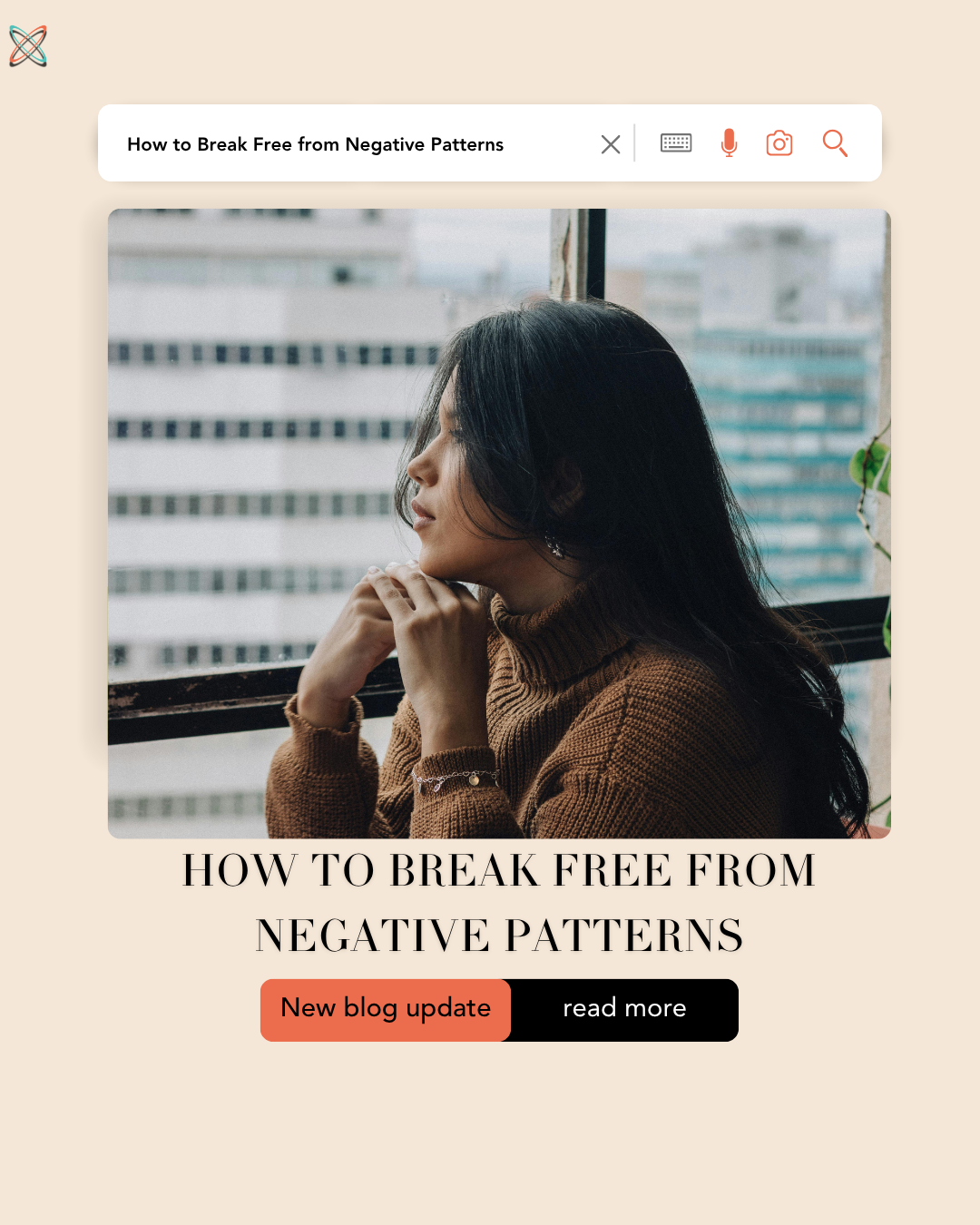
How to Break Free from Negative Patterns
BY YOLANDE CLARK-JACKSON
You may have promised yourself this time will be different. You’ve read the books, made the plan, and the conversation. And somehow, three weeks later, you’re standing in the exact same spot, doing the exact same thing you swore you were done with.
The good news is that it's not a willpower problem. You can’t break a long held pattern by trying harder. The not-so good news is because you’re standing inside it, most of what holds your pattern in place is invisible to you.
Why we keep doing what we want to stop doing
Patterns form because, at some point, the behavior worked. It got you something you felt you needed at the time: love, safety, approval, or relief from something worse. Your nervous system learned the pattern as a survival strategy before your conscious mind had a vote. So when you try to change it because you logically know things could be better, it doesn’t work. Your ego doesn’t listen to logic. It listens to whatever kept you safest and most comfortable once before and then begins to rely on it until it becomes a pattern.
That’s why new information rarely changes behavior on its own, explains The National Library of Medicine. You can know exactly why you shut down in conflict, or why you keep choosing the same kind of relationship, and still do it again next week. Self awareness only starts the process. There are a few things that have to change before the shift in the pattern takes place.
Why the people closest to you can keep the pattern going
The people who love you most and spend the most time with you are often the ones least likely to help you change. Not because they want you to stay stuck, but because they know you as you’ve always been.
We all know that person who always ends up taking care of others but is also often the one holding everything together, at work, in her friendships, in her family. She didn’t choose that role consciously. It just became hers, one small accommodation at a time, until “the reliable one” wasn’t a description anymore, it was an identity.
Everyone around her benefits from her staying exactly that reliable. So when she starts saying no, or asking for help, or admitting she’s tired, the people closest to her don’t always know how to respond.
Family systems therapists call this homeostasis, where relationships settle into a balance, and everyone in the system, often without meaning to, works to keep that balance intact. So, if you’ve always been the peacekeeper, the fixer, the one who doesn’t ask for much, your closest relationships have built themselves around that version of you. When you start to change, the system pushes back. Because a change to your position may mean others have to change too.
That’s why the same advice given by a partner or parent can land differently than it does from someone with no history or relationship dynamics to protect.
Why an outsider’s perspective can help
Sometimes a person outside your closest circle can see the pattern more clearly because they have enough distance from the situation and nothing to lose or gain. They don’t need you to stay the same for their own comfort. They also have narrative distance to see the shape of the story you’re inside, instead of just the scene you’re currently standing in.
As poet John Dryden put it, “We first make our habits, and then our habits make us.”
An outsider can help you see your habits clearly enough to suggest how making a different choice next time could get you closer to your goal.
It’s often an outside voice, a therapist, a coach, a new friend with no stake in the old dynamic, who first says out loud: “You don’t have to keep doing this.”
Things you can do now
Name the pattern in one sentence, out loud or on paper. You can’t change what you haven’t named.
Notice who benefits when you stay the same. Not to assign blame, just to see the system clearly.
Pick one small moment this week to respond differently than you normally would.
Ask someone outside your closest circle what they notice about you that the people closest to you might not say.
How therapy can help
A good therapist offers what your closest relationships often can’t: distance without disconnection. And a therapist who partners with your goal is invested in your growth, not in preserving the version of you that’s easiest for everyone else. They’re trained to help you trace a pattern back to where it started, understand what it was protecting you from, and build something new in its place. Most importantly, they work at a pace that helps you build new patterns of empowerment that going it alone rarely can.
Are you ready to break free?
If you’re ready to see your patterns clearly and finally shift them, Ibisanmi Relational Health is a committed group of trained Marriage and Family Therapists (MFTs) offering in-person and online Therapy. Get the support you need today with a free consultation. Book now.