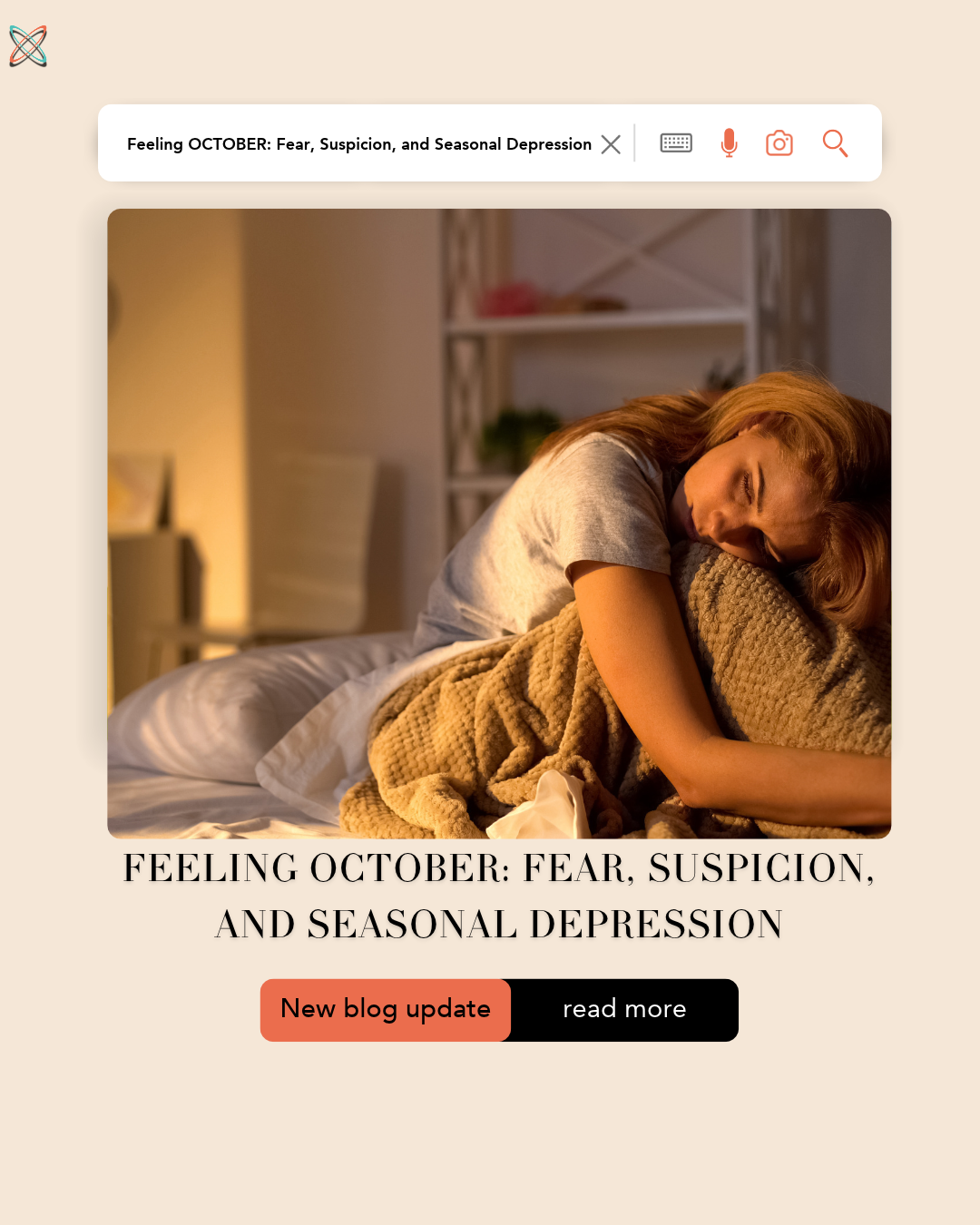
Feeling October: Fear, Suspicion, and Seasonal Depression
-Yolande Clark-Jackson
Maybe it's just me, but every hour of daylight we lose seems to add fuel to my racing thoughts. If you've noticed a "something is off" feeling creeping in when you walk down the street, you're not alone.
Not feeling this season? Well, fall is ripe with imagery designed to unsettle us. Soft whites and pinks are replaced with black and orange. Witches, ghosts, and jack-o-lanterns are popping up in every store we enter. It's no surprise that irrational fear, paranoia, and seasonal depression often overlap this time of year. Many of these feelings can be justified, and there are real tools that help, including more daylight, better sleep, and mental health support.
Read on for ways to come out of the rest of the year stronger, and for how therapy can help.
When fear gets louder in the fall
There’s a difference between paranoia and irrational fear. Paranoia is a persistent sense of being watched, judged, or targeted. A fear labeled “irrational” simply means it’s out of proportion to the threat. So if you think every room you walk into, people are talking about you, that may be paranoia. An irrational fear is one that is out of proportion to the actual threat, like avoiding the grocery store because you're sure something terrible will happen there when nothing points to danger.
Both can be fed by our own prejudices, the news we consume, or something someone once told us. For some people, both grow louder in the fall, because low light, disrupted sleep, and isolation can intensify them, confirms NY licensed therapist, Christiana Ibilola Awosan.
There’s also another side to this, of course. When past experience, racial trauma or family dysfunction makes caution reasonable, your instincts aren’t wrong. The right therapist, however, can help you sort your protective instinct from anxiety without dismissing either.
Seasonal depression is real depression
About 5 percent of U.S. adults experience Seasonal Affective Disorder or SAD, and it typically lasts about 40 percent of the year. Common signs: oversleeping, fatigue, withdrawal, hopelessness, appetite shifts. According to the National Institute of Mental Health, many people experience times in the year when they don’t feel like themselves.
SAD symptoms can start in the late fall or early winter and go away during the spring and summer, which is “known as winter-pattern SAD or winter depression.
For those living with it, being told to "get over it," or that what they feel isn't real, can make everything worse. It is real, and it is treatable.
Who carries more of the weight
Depression can affect anyone, regardless of income or background. But some of us face extra hurdles: cultural stigma, cost, the "strong woman" expectation, and too few culturally competent providers.
Women. In a 2023 APA poll of 2,227 adults, 29 percent of women said the fall time change had negatively affected their mental health in past years, compared with 16 percent of men. Add caregiving loads, hormonal shifts, and the pressure to hold everything together through the holidays, and it's easy to see why.
People of color. The gap here is less about how often mental illness occurs and more about who gets help. SAMHSA's 2025 data shows 40.5 percent of Black adults with a mental illness received treatment, compared with 50.9 percent of adults overall, even though Black adults reported a lower rate of mental illness than the national average.
The need is not the problem. Unfortunately, getting to care that understands you, often is.
Why a thought partner helps
Therapy gives you tools: sleep and routine strategies, conversations about light therapy, techniques for spiraling thoughts, and a way to check whether a fear fits the threat. A trusted professional also offers perspective you can't get alone in your own head. A good fit matters, and it is fine to try more than one provider.
Most importantly, you are not powerless. A few small daily habits can ease some of the anxiety and stress:
Take a daylight walk
Keep a consistent sleep schedule
Schedule one standing check-in with someone you trust
Journal
Start today
Don't wait for a crisis. You don't have to figure this out alone, and it's a process. If you live in New York or New Jersey, Ibisanmi Relational Health therapists are here to support you.
Whether you're looking for individual, couples, or family therapy, book a free consultation with one of our culturally affirming therapists to get started.
If you or a loved one is in crisis, call or text 988, available 24/7